

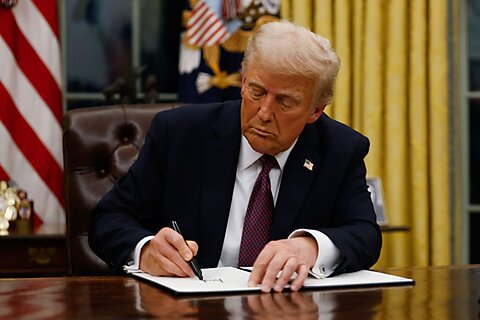

President Donald Trump’s executive order on debanking is a mixed bag. It’s less aggressive than his tone on TV when he accused banks of discriminating against him and his supporters. Yet, it still leaves open several questions.
At a glance, the executive order requires the following:
Regulators must remove the use of reputational risk regulation.
Banks must offer accounts to previously debanked customers.
Regulators must investigate internal bank policies.
Regulators must investigate religious discrimination.
The Treasury must develop a comprehensive strategy to address debanking.
Now let’s get into what’s good and what’s bad here.
Removing Reputational Risk Regulation and Investigating Issues
The first positive note in the order is the end of reputational risk regulation. The idea behind regulating reputation is that a business’s reputation can impact its bottom line—resulting in both success and failure. There is truth to that. The problem, however, is that gauging reputation can be an extremely subjective process. And it is for that reason that deciding how business activities affect reputation is a practice best left to individual businesses.
The next positive piece of the executive order is that it prioritizes further investigating the issue of debanking. The Department of the Treasury was tasked with developing a “comprehensive strategy” to “combat politicized or unlawful debanking activities of financial regulators and financial institutions.” Part of that effort is investigating financial institutions to find out if any of them have formal or informal policies that encourage political or religious debanking. After that, regulators must then review “current supervisory and complaint data to identify any financial institution that has engaged in unlawful debanking on the basis of religion.”
So, in short, the government will stop policing banks’ reputations and investigate whether there are internal bank policies that have encouraged debanking.
Open Questions That Need to Be Resolved
It may not be binding, but the most confusing part of this executive order lies in its first proclamation. The order states that it is the “policy of the United States” that no one should be denied access for “constitutionally or statutorily protected beliefs, affiliations, or political views.” While likely well-intentioned, it’s unclear what this actually means in practice.
To the administration’s credit, the term “politicized or unlawful debanking” is formally defined in the order. However, again, that definition is not exactly helpful for understanding what this term means in practice:
The term “politicized or unlawful debanking” refers to an act by a bank, savings association, credit union, or other financial services provider to directly or indirectly adversely restrict access to, or adversely modify the conditions of, accounts, loans, or other banking products or financial services of any customer or potential customer on the basis of the customer’s or potential customer’s political or religious beliefs, or on the basis of the customer’s or potential customer’s lawful business activities that the financial service provider disagrees with or disfavors for political reasons.
This definition effectively boils down to saying that political and religious debanking is defined as debanking someone for political and religious reasons. It’s likely one can safely assume that an internal policy explicitly stating that Christians and Muslims cannot have accounts would run afoul here. Yet, how this works beyond such an egregious example is a mystery.
The executive order also instructed the Small Business Administration to order financial institutions to effectively “rebank” the debanked. Specifically, the order says financial institutions must “make reasonable efforts to identify and reinstate any previous clients of the institution or any subsidiaries denied service through a politicized or unlawful debanking.”
This order is strange on many levels. Accusing businesses of wrongful discrimination and then ordering them to reestablish relationships borders on ordering self-incrimination. It’s one thing for the government to require damages to be paid after someone has been convicted of a crime. It’s another thing to skip the courtroom.
What’s Missing from the Executive Order
So, the executive order is a mixed bag. It’s good that it eliminates reputational risk regulation and prioritizes investigations over interventions. However, establishing a new policy for the United States and requiring the “rebanking” of customers opens many questions.
As Congress considers the next steps, it should remember that more is needed. Reforming the confidentiality around the Bank Secrecy Act and the supervisory process, for example, would go a long way toward achieving more transparency on debanking.


